The short version: for white and sushi rice, nothing near this price makes a more consistently fluffy bowl, and it does it without asking anything of you. It is also small, slow with brown rice, and dearer than pressure cookers that do more on paper. Here is where it earns the money, and where it does not.
The Verdict, Up Front
The Neuro Fuzzy makes the best everyday white rice you can buy without learning a single thing, and that is worth the money to precisely one kind of household.
Buy it if white or sushi rice is your daily bowl, you cook for one to four people, and you would like the machine to be the last thing in the kitchen you ever think about. Look elsewhere if you feed a crowd, if brown rice and mixed grains are the point rather than the occasional detour, or if you want the longest feature list per dollar; a pressure cooker will out-spec this comfortably.
Pros
- White and sushi rice come out fluffy and evenly separated, cook after cook
- It asks nothing of you: no soaking ritual, no watching the pot, no dialing anything in
- The menu range runs well past plain white, from porridge and sweet rice to semi-brown and brown
- Extended keep-warm holds a pot in edible condition across a long evening
Cons
- Listed at 5.5 cups uncooked, which runs out fast in a full household
- The brown rice cycle is slow enough that you plan around it
- Zojirushi backs the buy-it-for-life reputation with a listed 1 year limited warranty
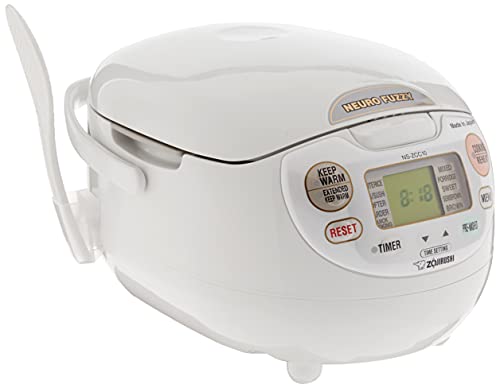
Zojirushi NS-ZCC10 Neuro Fuzzy Rice Cooker and Warmer, White, 5.5 Cup
- Neuro Fuzzy logic adjusts the cook as it goes for even, consistent rice
- Spherical nonstick inner pan for uniform heating, with an LCD clock and timer
- Menu settings for sushi, mixed, porridge, sweet, semi-brown, brown, rinse-free and quick

Build and Design: A Plain Box Hiding the Clever Part
Nothing about the outside of this machine is trying to impress you. It is a white plastic box with a hinged lid, a small LCD clock and timer, a retractable cord, and a control panel that looks like it was designed before anyone thought appliances should be beautiful. The interesting part is inside: Zojirushi lists a spherical nonstick inner pan, which is the whole design argument, because a round pan heats from every direction at once instead of just the bottom. The engineering budget went where the rice is, not where the showroom is.
The listed electrical rating is a modest 120 volts and 680 watts, which tells you this is a gentle cooker rather than a brute. In the box, the listing says you get two measuring cups, a nonstick rice spoon and a holder for it, and a recipe booklet. Zojirushi also lists it as wall mountable, which is a strange flex for a rice cooker and one nobody we know has ever used.
The Neuro Fuzzy: a plain box, a spherical pan, and a small brain doing the work.
The Rice: Where the Money Actually Goes
“Neuro Fuzzy” is a marketing name wrapped around a genuinely useful idea. Rather than the blunt on and off of a cheap cooker, a small microcomputer watches the temperature and keeps adjusting the cook as it runs, which means it can correct for the things that ruin rice at home: slightly too much water, a colder kitchen, a different batch of grain. You do not dial any of that in. You rinse, you fill to the line, you press one button.
What comes out, day after day, is the thing people pay the premium for: white rice with the grains separate and glossy rather than clumped, and a sushi setting that produces the slightly firmer, stickier texture that actually holds together under fish. The consistency is the real luxury. It is not that the Neuro Fuzzy hits a peak a good pot on the stove cannot; it is that it never misses, and never needs watching to not miss.
The menu list is broader than the reputation suggests. Zojirushi lists settings for regular white, sushi, softer and harder white, mixed rice, porridge, sweet rice, semi-brown, brown, rinse-free and a quick cooking cycle. Most owners use two of those forever, but the porridge setting in particular is a quietly excellent reason to own the machine.
Living With It
The keep-warm is the feature you stop noticing and would miss instantly. Zojirushi lists automatic keep-warm, an extended keep-warm and a reheat cycle, and in practice a pot cooked at seven is still perfectly good to eat when someone drifts in at ten. Cleanup is one nonstick pan and the inner lid, which is about as low as the burden goes for a machine of this kind.
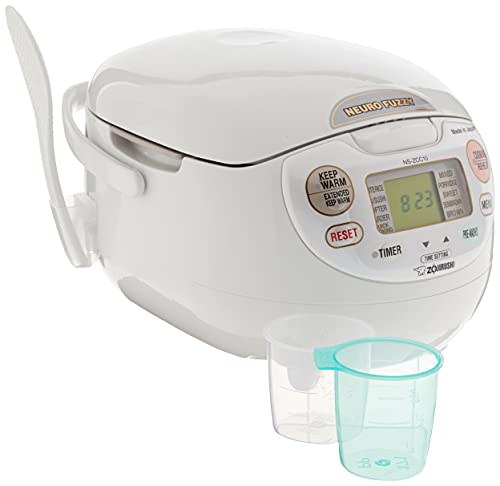 Two buttons get used forever; the rest are there for the week you get ambitious.
One genuine trap: the listing is emphatic that you measure rice using only the cup supplied in the box. The capacity rating is quoted in those cups, not in US measuring cups, so a household that reaches for the nearest Pyrex jug will get the water ratio wrong and blame the cooker. Read that line once and the machine behaves forever. If you are still weighing this against the wider field, it sits at the top of our roundup of the best rice cookers.
Downsides and What to Know Before Buying
The capacity is the first honest limit. Listed at 5.5 cups uncooked, it suits a small household and starts to feel tight the moment you are cooking for a table. The brown rice cycle is the second: a gentle non-pressure cooker has to soak and coax whole grains rather than force water into them, and the result is good but slow enough that you plan dinner around it.
Then there is the money. Around $268 on our August 2026 price check, it costs more than pressure cookers that hold more, cook faster and carry longer menu lists, and the buy box was a third-party seller rather than Amazon itself, so both price and availability drift more than you would like on a mainstream appliance. The warranty deserves a mention too: for a machine sold on a reputation for lasting decades, Zojirushi lists a 1 year limited warranty and nothing more. The durability story is the brand’s standing among owners, not a promise on paper, and it is worth knowing which of those two you are buying.
None of that changes the verdict. It does change who the verdict is for.
How We Tested
We do not take manufacturer samples, and this was not one; it reached a contributor’s kitchen the ordinary way, though no dated purchase record was kept for it. This is a daily-driver assessment rather than a bench test: the Neuro Fuzzy has made a household’s actual rice, mostly white and sushi, with the brown and porridge cycles run often enough to judge them and the keep-warm left to do its work across real evenings. We put no instruments on it, so every figure here (the wattage, the cup rating, the menu list, the warranty, the price) is Zojirushi’s listed spec or a dated price check, flagged as such, and the longevity point is the brand’s standing among owners rather than a record of ours. The full methodology lives on our how we test page.
Should You Buy It?
If your daily bowl is white or sushi rice and you want it right without thinking about it, then yes, and the price stops mattering somewhere in the second month. This is a single purpose machine that does its one purpose better than anything near it, and does it unsupervised, which is a rarer quality in a kitchen than a long feature list.
Skip it if you regularly feed more than about four people, if brown rice and mixed grains are the staple rather than an occasional detour, or if you simply want the most machine per dollar. The Cuckoo CRP-P0609S answers all three: high pressure, more capacity, more menus, less money. We put the two of them against each other properly in our Zojirushi vs Cuckoo comparison, and the split is clean enough that your rice habits decide it for you.
Zojirushi NS-ZCC10 Neuro Fuzzy Rice Cooker and Warmer, White, 5.5 Cup
- Fluffy, evenly separated white and sushi rice with nothing to dial in
- Spherical nonstick inner pan and a gentle non-pressure cook, with fewer parts under strain
- Extended keep-warm and reheat cycles hold a pot across a long evening