That is not a failure of the category. It is a failure of shopping. Almost every food processor comparison you will find is a ranked list, and a ranked list quietly assumes everyone wants the same machine. They do not. A couple who make pesto twice a month and a family who shred a block of cheese every weekend need genuinely different appliances, and the spec that matters most for one is irrelevant to the other.
This guide is for choosing, not ranking. We will work through the four decisions that actually separate one machine from another (bowl size, motor, blades and discs, and the everyday friction of owning it), explain why the biggest numbers on the box are the least useful, and point you to the right machine for how you really cook. Occasionally that answer will be no food processor at all. Let us sort it.
Start With the Job, Not the Machine
A food processor is a spinning blade in a bowl with a chute on top, and it is very good at a surprisingly narrow set of jobs. It chops and minces in bulk (onions for a week of sauces, a mountain of breadcrumbs); it slices and shreds through discs faster than any human with a box grater; it makes smooth, thick things like hummus, pesto, and nut butter; and it brings together pastry and bread dough without the heat of your hands. The design is old and settled. The machine began in 1960 as a commercial tool for French caterers, built by Robot-Coupe, and its domestic Magimix had reached British kitchens by 1974, a lineage Wikipedia’s history of the food processor sets out neatly. Fifty years on, the differences between machines are in the details, which is exactly why the details deserve your attention.
What it is bad at matters just as much. A food processor is a poor blender: thin liquids climb the central shaft and leak, and it will never make a silky smoothie. If the job you are really imagining is soup, an immersion blender does it in the pot for a fraction of the price, and if it is smoothies, you want a jug blender such as the Vitamix Explorian E310, not a processor. It is also overkill for one onion. By the time a full-size machine is assembled, used, and washed, a cook with a properly sharp chef’s knife has finished and moved on. And if every job on your list is small (a clove of garlic, a handful of herbs, salsa for two), a drawer-sized chopper like the BLACK+DECKER FreshPrep covers it for a fraction of the price of a full-size machine.
So before you look at a single spec, write down the three jobs you would actually use a processor for in a normal month. Everything below is about matching the machine to that list.
Bowl Size: Buy for Your Biggest Regular Job
Capacity is the first number on every box and the one people most often get wrong, usually by buying big “just in case”. The rough bands look like this:
- 3 to 4 cups: choppers. One blade, no discs, perfect for garlic, herbs, and dressings, useless for shredding.
- 7 to 9 cups: the small household size. Enough for a batch of pesto, a pie crust, or a block of cheese.
- 11 to 14 cups: the classic full size. Double batches, bread dough, coleslaw for a crowd.
- 16 cups and up: batch cooks, big families, and anyone who preserves or entertains seriously.
Two details make those numbers less straightforward than they look. First, listed capacity is dry volume, and liquid capacity is much lower. Because the blade sits on a central shaft, most bowls carry a maximum liquid line well below the rim; overfill past it and soup or batter seeps out around the stem and down the base. Check that line before you plan to make gazpacho in bulk. Second, a big bowl is bad at small jobs. A tablespoon of garlic in a 14-cup bowl gets flung around the walls rather than chopped, which is why some premium machines, Magimix most famously, nest a smaller bowl inside the large one.
The honest rule: buy for the biggest job you do every week, not the biggest job you do once a year. For couples and small households whose regular jobs are pesto, dips, crumbs, and the occasional crust, seven cups is plenty, and the KitchenAid is a good example of the size done well. KitchenAid lists a leak-resistant bowl and in-bowl storage for the blade and disc, which matters more than it sounds (see the friction test below).
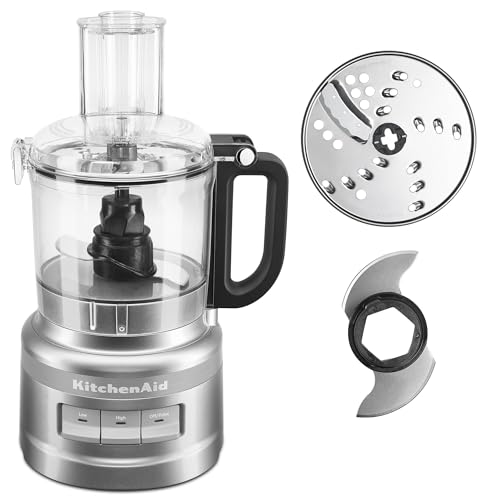
KitchenAid 7-Cup Food Processor KFP0718
- Seven-cup work bowl sized for couples, small households, and weekday batches
- Blade and reversible slicing and shredding disc store inside the bowl itself
- Twist-free, one-click bowl assembly with a latched, leak-resistant lid

Power: Why the Watt Rating Tells You Less Than You Think
Motor wattage is the spec manufacturers most like to shout about, and the one that tells you least. The first problem is the word “peak”. A peak rating is the most power a motor can draw for a moment, typically on start-up or under a sudden load, not what it can sustain through three minutes of kneading. The Ninja Professional Plus, for example, lists “1000 peak watts”; that is a legitimate figure, but it is not comparable with a machine rated on continuous power, so two numbers that look similar on a shelf may describe quite different motors.
The second problem is that watts measure the electricity going in, not the work coming out. What stops a machine bogging down in stiff bread dough is torque at low speed, and that comes from motor design and gearing rather than a bigger number on the label. Cuisinart’s classic 14-cup rates its motor at a modest 720 watts, while Breville lists 1450 watts for the Sous Chef 16; the Cuisinart is not twice as feeble for it. Judge a motor by what the maker is willing to promise about it, not by its wattage.
Two things are genuinely worth looking for. One is an induction motor. These are the heavy, brushless motors used in the premium machines, and they tend to be quieter and to cope better with sustained loads; Magimix even carries the Quiet Mark noise certification on its processors, and the Magimix that has lived in our kitchen for years runs with a restraint that makes early-morning pesto feel less antisocial. The other is the length of the motor warranty, which is the manufacturer putting money on the motor. Breville and Magimix both list 30 years; Cuisinart lists a full 5 years on the motor and a limited 3 years on the whole machine. Read the terms, though. The FTC’s advice on warranties is blunt: if a part is not listed as covered, assume it is not. A 30-year motor warranty is a promise about the motor, not the plastic bowl, which is the part that actually cracks. Our food processor reviews note each machine’s warranty terms alongside the motor claims.
Blades, Discs and the Feed Tube
Almost everything a food processor does well is done by the S-blade, the two-armed chopping blade at the bottom of the bowl. Every machine has one. Where machines really differ is in what sits on top.
Slicing and shredding discs are the reason to buy a processor instead of a chopper, and there are two kinds. Fixed discs cut at one thickness; Cuisinart is refreshingly candid that the slicing and shredding discs on its 14-cup model are not adjustable, and for most home cooking one medium slice and one medium shred is all you will ever use. Adjustable discs let you dial the thickness, from paper-thin cucumber to thick potato slices for a gratin. If precise, adjustable slicing is the entire reason you are shopping, be aware that a good mandoline does it more precisely for a fraction of the cost, at the price of more attention and a guard you must actually use.
The feed tube decides how much chopping you do before the machine can do its chopping. A narrow tube means halving every potato and quartering every block of cheese, which erodes the whole point. Wide or “extra-large” tubes take whole vegetables, and the widest, like Breville’s 5.5-inch chute, are designed by their makers to take a whole potato.
A dough blade is a nice extra rather than a necessity. It is a blunter blade that works dough without shredding the gluten, and machines like the Ninja include one; plenty of cooks knead successfully with the standard S-blade, in short bursts, for years.
For most households, a full-size machine with a proper S-blade, one good slicing disc, one shredding disc, and a wide feed tube is the sweet spot, and the Cuisinart 14-cup is the long-standing default for exactly that reason.
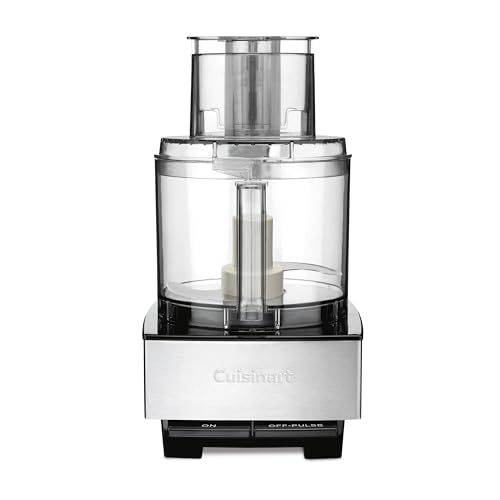
Cuisinart 14-Cup Food Processor DFP-14BCNY
- The classic 14-cup full size: double batches, bread dough, and slaw for a crowd
- Extra-large feed tube cuts pre-chopping; stainless slicing disc plus a shredding disc
- Listed full 5-year motor warranty and limited 3-year warranty on the whole unit
The Features You Can Safely Ignore
Food processors are simple machines that manufacturers keep trying to make complicated, and a surprising share of the price difference between models goes on features that do not change the food.
Presets are the obvious one. One-touch programmes for “chop” or “dough” are harmless, but a food processor’s job is judged by eye; you stop when the onions look right, not when a timer decides. A row of speeds is similar. Unlike a blender, a processor mostly needs two controls, on and pulse, and the pulse button is the one that matters, because short bursts are how you chop without turning onions to puree. The Magimix, among the most expensive machines you can buy, has three buttons: stop, auto, and pulse.
Giant accessory kits deserve suspicion too. A box of twelve discs looks generous, but most cooks settle on the same two or three within a month, and the rest become a storage problem. Pay for the attachments you would use this week. Finally, be wary of any “food processor” that is really a blender jug with a processing lid bolted on; these combination machines tend to be adequate blenders and frustrating processors, because a tall narrow jug is the wrong shape for chopping.
The Friction Test: Assembly, Cleaning, Storage
Here is the least glamorous and most important part of the decision. The best food processor is the one that is easy enough to get out that you actually use it, and machines fail this test far more often than they fail on power.
Count the steps between wanting chopped onions and having them. Where does the machine live? A full-size processor is heavy, and one that has to be lifted down from a high cupboard is one you will talk yourself out of using. If you have the counter space for it to stay out, you will reach for it constantly; if you do not, be realistic about size. Then assembly: does the bowl twist and lock in a particular order, or drop straight on? Then cleaning: how many parts, are they rated dishwasher safe, and are there crevices under the lid and around the stem where dough goes to hide?
Storage of blades and discs matters more than any spec sheet admits. Loose discs are sharp, awkward, and easily lost at the back of a drawer; machines that store them inside the bowl or in a dedicated case get used more simply because nothing needs finding. Before you buy, imagine making a single batch of pesto on a weeknight, start to finish, including the washing up. If that picture makes you tired, choose a smaller, simpler machine.
When the Big Machine Earns Its Space
There is a case for the enormous, expensive processor, and it is a specific one. If you batch cook every weekend, feed a large household, preserve, or entertain in volume, a big machine stops being indulgent and starts saving real time: fewer batches, less pre-cutting, and discs that give you control over the result.
The Breville Sous Chef 16 is the clearest example. Breville lists a 16-cup bowl, a 5.5-inch feed chute, an adjustable slicing disc with 24 thickness settings, a French fry disc, a dough blade, a 1450-watt induction motor, and a 30-year motor warranty. That is a machine designed around volume and precision, and the right cook will use every part of it.

Breville BFP810 Sous Chef 16 Cup Food Processor
- Sixteen-cup bowl and a 5.5-inch feed chute that takes whole vegetables
- Adjustable slicer with 24 thickness settings, plus shredding and French fry discs
- Heavy-duty induction motor with a listed 30-year motor warranty
Be clear-eyed about the costs, though. It is several times the price of a good 7-cup machine, and a 16-cup base claims a permanent patch of counter; it is not an appliance you will happily lift in and out of a cupboard. If your honest weekly job list is pesto and crumbs, the big machine is not better, just bigger.
Five Questions That Settle It
If you are still torn, answer these in order.
- What are your three regular jobs? If none of them involves slicing or shredding, you may want a chopper or a knife, not a processor.
- What is the biggest batch you make every week? Pesto and dips for two: 7 to 9 cups. Family batches and bread dough: 11 to 14 cups. Serious batch cooking: 16 cups.
- Will it live on the counter? If not, lean smaller and lighter; the machine you can lift is the machine you will use.
- Do you need adjustable slicing? If yes, look at adjustable discs, or consider whether a mandoline covers it. If no, fixed discs are fine and cheaper.
- How long do you want it to last? A long motor warranty is the best proxy for build quality you can read off a box. Check what it covers.
Most readers land on a 7-cup machine or a 14-cup one. Very few actually need the 16.
Buy for the Job You Do Every Week
Choosing a food processor is not a question of which machine is best. It is a question of which jobs you really do, how much of them, and how much effort you will tolerate before reaching for a knife instead. Get those three answers right and the specs that fill the box (peak watts, preset programmes, a dozen discs) stop mattering, because you will be looking at bowl size, motor warranty, disc choice, and how quickly the thing comes apart for washing.
For most small households, that points to a compact machine like the KitchenAid 7-Cup; for most families, a full-size classic like the Cuisinart 14-Cup. If you want to see how every machine we have used compares, our best food processors roundup has the full reviews. Whichever you choose, give it a place on the counter if you possibly can. A food processor does its best work in plain sight, not at the back of a cupboard behind the salad spinner.